Grain Bins in Nebraska

Project
Structure: Grain bins
Location: Dorchester, Nebraska
Size: 112 feet inside diameter, 140 feet tall
Team
Architect: McPherson Concrete Storage Systems
Structural engineer: McPherson Concrete Storage Systems
Owner: Farmers Cooperative
Steel erector: McPherson Concrete Storage Systems
Steel joist manufacturer: Gooder-Henrichsen Co.

Approaching the Task
This project started when McPherson Concrete Storage Systems was approached by an agricultural co-op to construct grain bins in Nebraska. Knowing they needed an economical and practical design, they approached part of the project with steel joist designs in mind. And with the help of Gooder-Henrichsen Co., they were able to bring that idea to fruition.
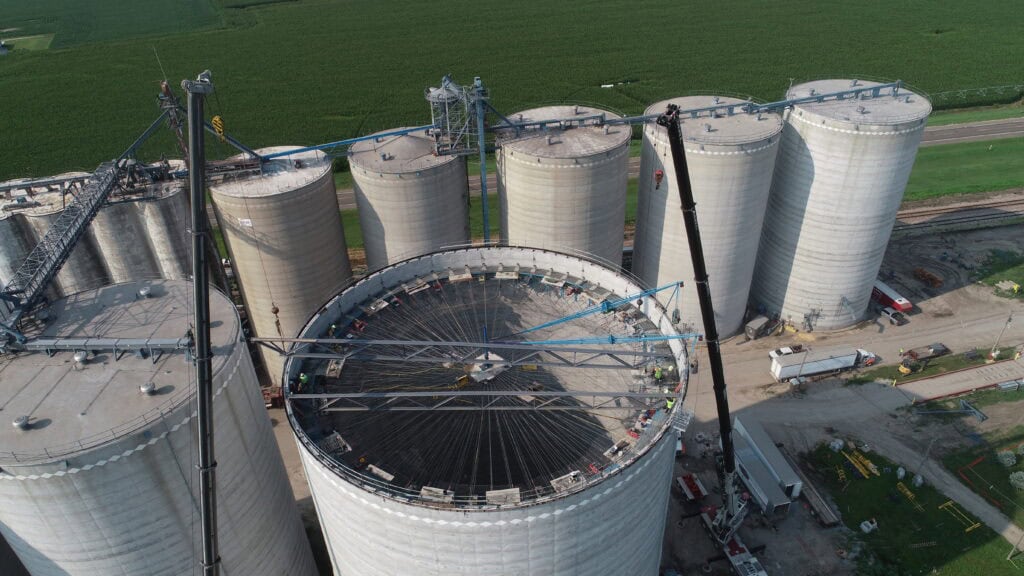
When construction was being planned, it was determined that two cranes were required due to the size of the material. On the 112-foot diameter roof, the four joist girders were each approximately 108 feet long and thus needed one crane lifting each end of the girder to safely set them in place. Thankfully, no weather impacted erection, and all that was needed was one day with two cranes to set all of the girders, joists and bridging in place.
Metal form deck was attached to the joists and concrete was poured to form the roof. Altogether, it took approximately 4 1/2 months from when the foundation was started to finishing pouring the concrete on the roof. The final result is a circular poured concrete structure using steel joists and joist girders to support the concrete roof.
Ensuring a Successful Build
The roof for the grain bin was constructed to be pitched at 1/4 inch to 12 inches from the center to the perimeter wall, while the joists and joist girders ran straight across. The girders and the center bay of joists were double pitched, but the pitch varies from one member to the next. The outer bays of joists were all different lengths with different pitches to the seats. Engineering produced many setup diagrams for the shop with a very experienced line foreman overseeing production.
Girders and joists were the most economical and practical solution for supporting the loads at the span. The loads included the concrete roof plus the equipment on top of the roof. For the span and loading, the only practical options were custom steel trusses or joists and girders. Custom-designed and fabricated steel trusses would have been more expensive than joists.
McPherson Concrete Storage Systems
What made these bins unique to construct was that they are round and made completely of poured concrete. Because of this, the joists are almost all different, which meant there were multiple factors to account for including loading differences and different dimensions. This structure is also rare because all-poured concrete structures are not very common except for things like dams and bridges.
A previous design for these large-diameter roofs used standard long-span joists to clear span from one side of the structure to the other side. Changing the design for large-diameter grain bins to one that uses girders with three bays of shorter joists enables the customer to fill the silo with more grain. It also decreases the laydown space needed at the jobsite and reduces the risk of damaging joists during offloading, staging and erection.
How Steel Joist Can Impact Designs
Steel Joist Institute girders, joists and accessories can be a cost-effective solution, even for structures that are out of the ordinary such as this one. These products are obvious for a flat roof, and most architects and engineers are also used to specifying special configurations like double-pitched joists and bowstring joists for schools. However, these are an excellent solution even for a round industrial structure with a low-pitched conical roof. Double-pitched roof systems allow roofs to shed water properly, although aesthetics almost seem like a flat roof system.
The Steel Joist Institute and its member companies continue to innovate to expand the practical use of steel joists and girders as cost-effective solutions for multiple applications. Whether the need is solely for a functional design, as in industrial buildings, or aesthetics are an important consideration, as in schools or public buildings, architects and engineers will find that SJI products offer an economical solution to meet their project requirements.